
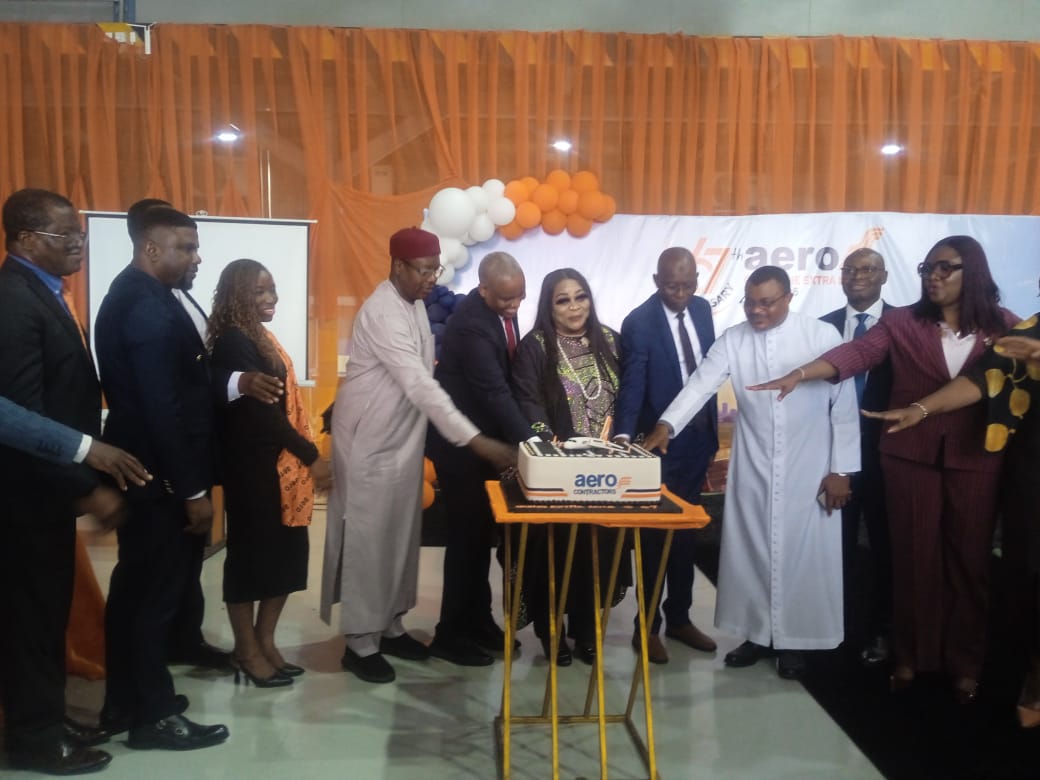
Dignitaries cutting the cake to celebrate 67th year anniversary of Aero Contractors Airways on Monday at the headquarters of the airline in LagosThe Managing Director and Chief Executive Officer of Aero Contractors Airways, Captain Ado Sanusi has appealed to the Federal Government to recognise the airline recognized as a National Treasure, protected, and positioned as such, to serve this nation for the next sixty-seven years, and beyond.
He made the appeal in Lagos on Monday during the 67th year anniversary celebrations of the establishment of the airline.
Sanusi who appreciated President Bola Tinubu’s Renewed Hope Agenda and the Minister for Aviation of Aviation and Aerospace Development, Mr. Festus Keyamo SAN for the renovation of Murtala Muhammed International Airport, Ikeja, Lagos, however requested for a firm Renewed Hope Agenda for Aviation, where the industry should be a fulcrum and catalyst for economic growth through tourism, trade, jobs and foreign investment.
Speaking on the challenges facing the industry, Sanusi warned that Nigeria is slipping down the ladder as other nations are building new mega-airports and a major maintenance hangar with the eye to equally serve the Nigerian market, and if nothing strategic is done Nigeria risks her airports becoming ghost structures.
In his speech at the event tagged: ‘Going the Extra Mile,’ he said Aero Contractor is making a bold statement of its resilience in weathering storms of challenges and maintaining high standards in an industry nationally noted for high mortality rate.
The CEO who recalled that Aero Contractors started as a small company flying men and equipment to the oil fields of the Niger Delta to become one of Nigeria’s iconic aviation companies, said the resilience of the airline deserves special recognition.
According to him “I came to tell you a story of resilience. We have grounded fleets and empty hangars and still, we flew. We have gone months without a single aircraft in the sky, and still, we flew. We have buried colleagues, gone without pay, and watched the world write us off, and still, we flew.
“That is not luck. That is not chance. That is the quiet, stubborn dedication of the men and women of Aero Contractors, the engineers who stayed back long after their shifts ended, the pilots who kept current on their licences even when there were no aircraft to fly, the cabin crew, the ground staff, and every support team who kept this airline alive through years of uncertainty. Today, we honour them, not with words alone, but with a solemn commitment to never again take their sacrifice for granted.
”The airline commenced services in 1959 as a charter and crop-spraying operation, before becoming a vital lifeline to the oil and gas industry. It’s major backbone was rotary wing operation, with the support of its defunct foreign technical management that carried Nigerians to places no road could reach, and through the training school that has shaped generations of Nigerian pilots and engineers, the airline was able to establish itself as a flagship of Nigerian airline industry. In the year 2000, it launched scheduled passenger services covering most cities in Nigeria and the West Coast, making it the longest serving schedule career in Nigeria today. On January 4, 2018, after fourteen years in which no Nigerian Airline had performed a C-check on a Boeing 737, the airline’s engineers, working from its hangar in Ikeja completed Nigeria’s first indigenous C-check: the first of its kind not just in Nigeria, but across the whole of West and Central Africa. Today, Aero Contractors stands as a fully integrated Aviation Enterprise, Scheduled Operations, Charter and Rotary Wing, Maintenance and Repair Overhaul (MRO), and Pilot Training, and the MRO now serves sister carriers across West Africa.
In 2016, when the airline’s fortunes were at its lowest, the Asset Management Corporation of Nigeria (AMCON) stepped in, took a majority stake, and gave the Airline a second chance at life. The MRO has upgraded to state of the art smart tools that have chips in them, new equipment and extension of hangar to serve the West and Central African markets.
Sanusi said: “The resilience now shows in our numbers too, from an operating margin of minus 134 per cent in 2022 to a positive operating margin by 2025. That is why this legacy must not be allowed to fade. Sixty-seven years is not a number, it is a living memory, carried by every Nigerian who learned to trust the skies because of us, and by every young Engineer and Pilot who cut their teeth in our hangars and cockpits.”