
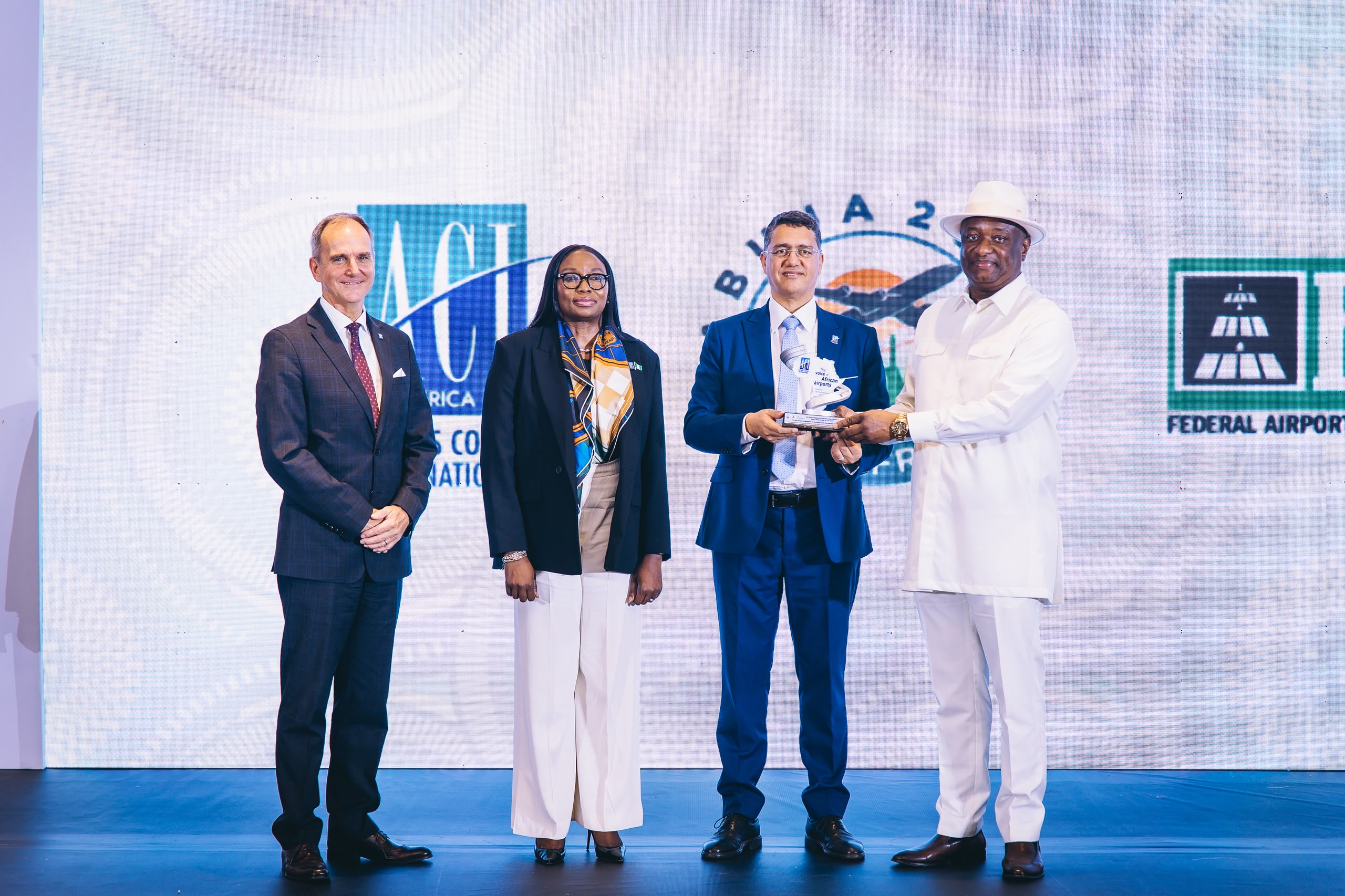
Minister of Aviation and Aerospace Development, Mr Festus Keyamo ( SAN) has renewed the call for stronger intra-African connectivity to boost air transportation, tourism, investment among others.
He made the call in Abuja on Tuesday at the Opening Ceremony of the ongoing 35th ACI Africa Annual General Assembly, 76th Board and Committee Meetings, Regional Conference and Exhibition.
Keyamo who recognised Africa’s comparative advantages in market, people, geography, tourism assets and the entrepreneurial energy, said, ” What we must do is build the infrastructure, policies, connectivity and institutional capacity to convert this enormous potential into sustainable value.
Noting that poor intra-African connectivity has remained a major set back to the realisation of African potential in tourism, business, logistics and investment drive, the Minister affirmed that challenge must be confronted collectively and whole-heartedly.
“There is, significantly, one challenge we must confront collectively, and that is the challenge of connectivity.
Keyamo who believed that It should not be easier to travel between an African city and a destination outside the continent than to travel between two African cities, said “Africa needs stronger intra-African connectivity, commercially viable airports, appropriate regulatory frameworks and closer cooperation among governments, airlines, airport operators and other stakeholders”
He therefore urged stakeholders to tap into the opportunity offered by the Single African Air Transport Market (SAATM) as an important framework for achieving this ambition.
“The African Continental Free Trade Area is creating a larger economic space. Aviation must help make that economic integration real. When African airports connect Africa more effectively, Africa becomes smaller, and opportunity becomes larger,” he said.
Believing that passengers experience remained a central focus of aviation businesses, Keyamo affirmed that deployment of technology will go a long way to help maximise this He therefore urged African airport operators to begin looking into benefits inherent in operating smart airports.
“Ladies and gentlemen, the future of airports must ultimately be measured by the quality of the passenger experience.
Biometrics can make processing easier. Artificial intelligence can improve operational decisions. Automation can reduce queues. Data can help us anticipate demand. Digital platforms can improve communication. But technology is only meaningful when it makes a person’s journey safer, easier, faster and more dignified.
“We must therefore build smart airports with human hearts,” he said.
He therefore called for collective action on this, with a note that this is where ACI Africa has an indispensable role to play.
He said, “No country has all the answers. No airport can solve every challenge alone. But together, we can share experience, benchmark performance, develop capacity, attract investment and advocate policies that strengthen African aviation.”
Earlier in her welcome speech at the event, themed: “Next-Gen Airports: Driving Performance and Resilience,” the Managing Director/Chief Executive, Federal Airports Authority of Nigeria (FAAN) and Vice President, Airport Council International Africa (ACI-Africa), Mrs Olubunmi Onabanjo-Kuku, had called for deliberate, strategic action at facing some notable challenges despite notable achieved progress in aviation industry in Africa.
Kuku who reeled out impressive data on the performances of African aviation at wordstage in 2026, however noted that .Africa’s aviation sector faces structural headwinds that must be confronted with clear eyes and collective resolve.
According to her, “the latest data from the International Air Transport Association (IATA), African airlines recorded a 6.4 per cent year-on-year increase in international passenger demand in July 2026. While global international demand actually declined by 0.1 per cent during the same period, Africa was expanding. We are not just participating in global aviation recovery—we are leading it. And I am proud to be standing in the same room with the men and women moving Africans and their visitors safely and in comfort.
“Our continent’s overall passenger demand grew by 5.2 per cent, second only to Latin America and the Caribbean, and substantially ahead of the global average of 0.2 per cent. This is not a marginal improvement. This continent is on the move.”
She continued, “these figures are not abstract. They represent millions of Africans connecting with family, doing business, accessing healthcare, and exploring opportunities.
“Our continent accounts for just 1 per cent of global air traffic despite having 18 per cent of the world’s population. Load factors remain below global averages, and our airlines’ financial viability remains fragile.
“In Nigeria alone, with a population exceeding 220 million, we record approximately 19.5 million passengers annually across 28 airports.
“The potential is vast, but the gap between where we are and where we could be remains substantial. This is not a reason for despair—it is a reason for deliberate, strategic action.
“The challenges are real: funding constraints, infrastructure gaps, high operating costs, fragmented connectivity, and the persistent pressure to keep charges low while delivering world-class facilities.These are the very issues this conference has been designed to address.” Kuku said.
She however challenged partici[pants especially from Africa, at the event to consider what the African airport of 2036 should look like, and how to get there.