
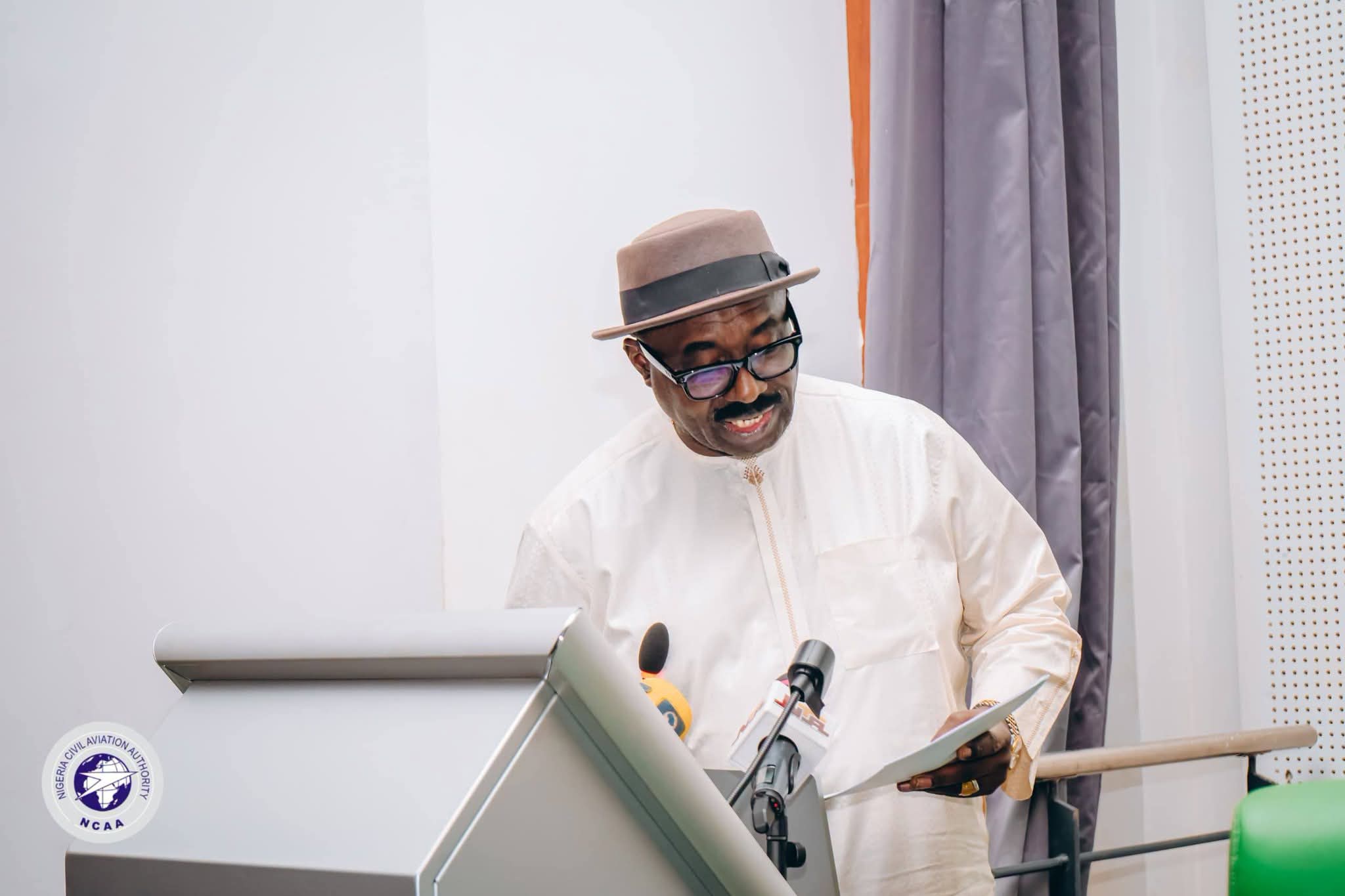
The Director-General, Civil Aviation (DGCA), Capt. Chris Najomo, has cautioned against any further reduction in the Authority’s statutory allocation which could significantly undermine Nigeria’s aviation safety oversight capability.
Capt. Najomo gave the warning during the public hearing on the proposed review of the Allocation of the 5 per cent Ticket Sales Charge (TSC) and Cargo Sales Charge (CSC), organised by the House of Representatives Committee on Aviation on Thursday, August 6, 2026, at the National Assembly Complex, Abuja.
The DGCA stated that, while the Authority supports adequate funding for all aviation agencies, any review of the existing revenue-sharing formula will weaken the NCAA’s capacity to effectively discharge its statutory regulatory responsibilities.
He noted that the NCAA remains heavily dependent on the TSC, constituting 85 percent revenue for effective discharge of its statutory mandate. On the other hand, the Nigerian Airspace Management Agency (NAMA) already derives a substantial portion of its revenue from commercial charges paid by aircraft operators for the air navigation services it provides.
Citing the International Civil Aviation Organization’s (ICAO) Policies on Charges for Airports and Air Navigation Services (Doc 9082), Najomo explained that the cost of air navigation services is intended to be recovered principally from aircraft operators who use those services, rather than from passengers through the TSC.
According to him, should the NCAA’s statutory funding be further reduced under the present circumstances, the Authority cannot responsibly assure the distinguished committee that it will be able to sustain the level of safety oversight necessary to guarantee the continued safety of Nigeria’s civil aviation industry.
Capt. Najomo noted that, if additional funding is required for the Nigerian Airspace Management Agency (NAMA), such support should first be pursued through the optimisation of its statutory commercial revenue streams, improved operational efficiency and corporate governance, and, where necessary, targeted government support for strategic capital infrastructure in line with ICAO policy and international best practice.
In their separate remarks, the former Nigeria’s representative on the ICAO Council, and immediate past DGCA, Capt. Musa Nuhu, and Nigeria’s Permanent representative to ICAO, Engr. Mahmud Ben-Tukur, emphasized that, while every aviation agency has a distinct statutory responsibility, the responsibility for the safety oversight of Nigeria’s civil aviation industry rests solely with the NCAA.
They, therefore, expressed deep concern that treating the regulator and service providers alike in the proposed funding arrangement could undermine the independence of the regulator, stressing that an effective aviation industry depends on a strong, adequately funded, and independent safety oversight authority.
Also speaking virtually, the former Nigeria’s permanent representative to ICAO and former President, ICAO Assembly, Dr. Bernard Aliu, and former Director-General of Civil Aviation, Dr. Harold Demuren, echoed similar sentiments, underscoring the need to preserve the financial independence of the NCAA, noting that a strong, adequately funded and independent regulator is critical to sustaining Nigeria’s aviation safety oversight system and maintaining the country’s compliance with international aviation standards.
The public hearing was attended by members of the National Assembly committees on Aviation, including their chairmen, Sen. Abdulfatai Buhari and Hon. Abdullahi Idris Garba, heads of aviation agencies, airline operators and other industry stakeholders.