
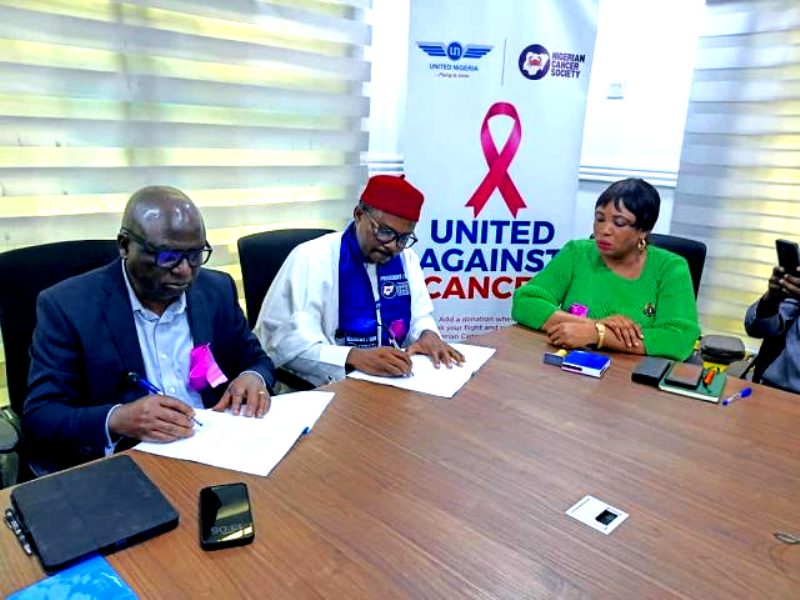
“I am a cancer survivor myself, and I also have my sister died of cancer. My two sisters, actually, were cancer victims,” Okonkwo said. He explained that sharing personal experiences could give hope to people confronting similar challenges. “We are not shy talking about it because if you are able to tell the story, it gives hope to the other person who may be having that problem or who may think that this is a death sentence. It is not.
“We have heard the news, and we have seen people who have been affected by this deadly disease. It is on that basis that United Nigeria has decided to work with the Nigerian Cancer Society in a special way to mount a campaign against cancer in Nigeria. We have looked at the programmes and activities of the Society, and we are very happy with them. We believe they need to be supported, not only by United Nigeria Airlines through the United Nigeria Airlines Foundation but also by the passengers who fly with us and book tickets on our platform.
“Our passengers would have the opportunity to contribute to the fight against cancer in a very simple but unique, innovative way. You book a ticket and have the option to make a voluntary contribution on our platform. You can give as little as N1,000, N2,000, N5,000, N100,000, and so on. That is the first stage of the campaign. All the money and donations raised will go directly to the Society, into an account designated by the Society for this purpose.
“The second level is that some cancers will not be caught at that early stage, and those patients will need treatment. Successful treatments have been recorded across the board. This is also a personal matter for some of us. I mentioned that we have our own personal stories. I am a cancer survivor myself. I also lost two sisters to cancer; both were victims of this deadly disease. We are not shy about talking about it, because when you tell the story, it gives hope to someone who may be facing this problem or who may think it is a death sentence. It is not,” Okonkwo said.
Under the partnership, UNA will introduce voluntary donations through its online ticket booking platform. Passengers purchasing tickets can contribute from ₦1,000 upwards. They can also donate ₦2,000, ₦5,000, ₦100,000 or any amount they choose.
Okonkwo explained that all donations would go directly to an account designated by the Nigerian Cancer Society. The society will receive the funds and apply them to its cancer-related programmes. This arrangement allows passengers to support cancer awareness and interventions without making separate fundraising arrangements.
The airline also informed that it plans to extend the cancer awareness fundraising beyond its website. It explained that information materials will be placed in aircraft seat pockets, giving passengers another opportunity to participate. Those who miss the online donation option can make transfers or contribute through other designated channels. .
Okonkwo said the airline would use its extensive domestic passenger network to spread information about cancer awareness. He also appealed to journalists and media organisations to sustain public education beyond the launch. According to him, small contributions from many passengers could collectively make a significant difference.
Okonkwo said United Nigeria Airlines has committed to making its platforms and flights available to the Society, not only to raise money but also to raise awareness about the disease.
According to him, UNA’s cabin crew will lead the campaign on board, making announcements and engaging passengers directly. Passengers will find information in the seat pockets in front of them, and co-branded materials will appear at check-in counters.
The website is the airline’s main channel for fundraising. The airline also plans to reach passengers who did not book through the website, and it is encouraging its followers and media partners to share the campaign with Nigerians.
He said: “The website is our main target for fundraising. But we are going to the next level by putting information in the seat pockets behind every passenger’s seat. We are appealing to those who may have missed buying their ticket through the website to also chip in, by making a transfer or giving their spare change, to help a small baby or a poor woman who may have breast cancer or any other type of cancer. We are excited. We know that Nigerians are very generous, and I am using this platform to appeal to them. I think it is already live on our website, and I would encourage you to spread the good news using your various channels and platforms to inform Nigerians about the campaign.”
Also speaking at the briefing, the National President and Chief Executive Officer of NCS, Prof. Abidemi Omonisi, a pathologist, described the partnership as an important intervention in addressing the funding challenges facing cancer care in Nigeria.
He commended the airline for taking the initiative and noted that the programme was conceived and driven by UNA as part of its corporate social responsibility.
Omonisi who stressed the financial burden that cancer places on families, described it as a catastrophic illness capable of impoverishing even wealthy households.
“Advanced therapies like immunotherapy can cost up to N50 million,” he said, and rural patients often face transport costs and temporary housing in major cities, which can force them to abandon treatment partway through. He said the funds raised through the airline’s platform will directly support nationwide early screening, diagnostic assistance and treatment for indigent patients in urban centres and underserved rural communities.
Omonisi affirmed that the greatest gains lie in early detection. Patients diagnosed at early stages have better chances of successful treatment.
The President and Chief Executive Officer of NCS who noted that organised national screening would be the most critical way to save lives in developing nations, however cautioned against one-off screening exercises that identify positive cases without providing continuous patient support, leaving people abandoned.
He therefore called for sustained health education and community outreach to dispel myths, such as mistaking early breast cancer symptoms for minor boils or attributing tumours to spiritual attacks.
Beyond late diagnosis, the financial burden of cancer treatment remains a major challenge. Omonisi described cancer as a catastrophic disease capable of overwhelming even financially comfortable households. He cited immunotherapy as an example, saying a standard treatment could cost approximately ₦50 million.
The financial consequences extend beyond hospital bills. Many cancer centres are concentrated in major cities, forcing patients from rural communities to travel long distances. Some families sell houses, cars and other properties to finance treatment. Others struggle to afford transportation, accommodation and repeated hospital visits.
Omonisi said some patients manage to begin treatment but cannot afford to complete it. This creates another serious problem because interruptions can undermine treatment outcomes. He also highlighted the dangers face by patients who abandon hospital appointments because they cannot afford transport to treatment centres.
Consequently, the society believes cancer awareness must go hand in hand with practical support. Early detection remains the priority, but assistance with diagnosis and treatment is also necessary. The airline partnership could provide additional resources for addressing some of these difficulties.