
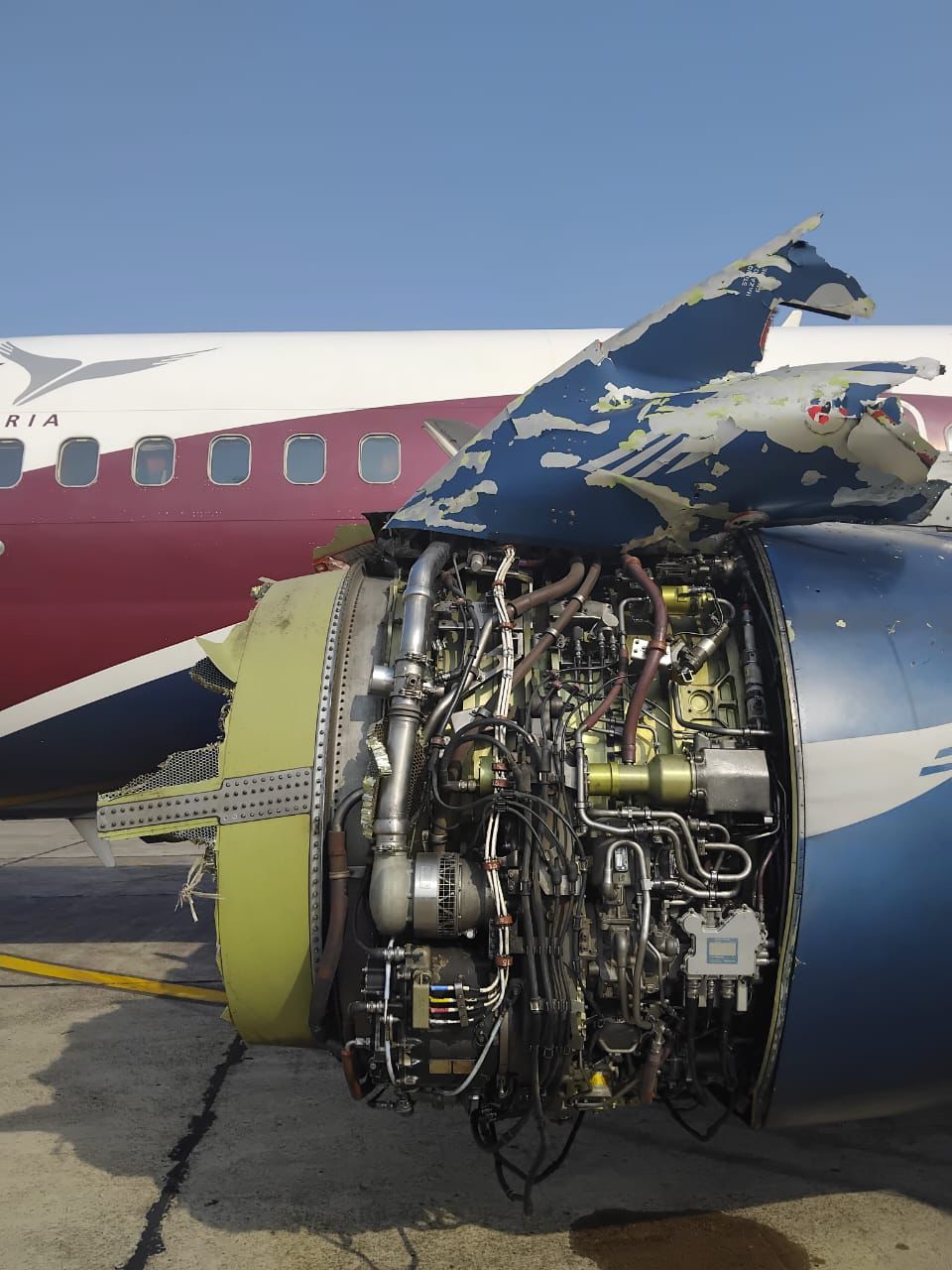
Pictures courtesy of Nigeria Safety Investigation Bureau (NSIB)
A scheduled flight operated by Air Air on Wednesday from Lagos (LOS) to Port Harcourt International Airport Omagwa (PHC) Airport was diverted to Benin Airport (BNI), Benin City, Edo State following an anomaly noticed on one of the engines of the aircraft, a Boeing 777-300ER, by the flight crew.
As a precautionary safety measure, the crew diverted the flight to Benin City, the alternate airport, where the aircraft was landed safely and all the 80 passengers on board were safely disembarked without anyone sustaing injuries.
In a statement by the airline’s Public Relations and Communications Manager, Adebanji Ola confirmed the incident in a statement made available to African Business Travel News (ABTNEWS).
He said the aircraft a Boeing 737-700 (5N MJF) deployed to operate the disrupted flight W3 740 from Lagos to Port Harcourt on Wednesday February 11, 2026, diverted to Benin Airport after the operating crew heard a loud bang on the left engine.
Ola explained further that the aircraft was on its decent to Port Harcourt International Airport, Omagwa when the incident happened and as a precautionary measure, the crew had to make a safe diversion to Benin where the passengers on board were safety.
The Arik Air’s spokesperson said arrangements were made to transport the affected passengers to their final destination.
Director, Public Affairs and Family Assistant, Nigerian Safety Investigation Bureau (NSIB) Mrs Bimbo Olawumi Oladeji in a statement confirmed that Arik Air reported the occurrence
She stated that NSIB has commenced an investigation into the occurrence In line with its statutory mandate and in accordance with international standards under ICAO Annex 13 and applicable Nigerian civil aviation regulations.
Oladeji disclosed that preliminary observations of the aircraft at the diverted airport indicated that the affected engine suffered significant damage.
“Preliminary observations at the diversion airport indicate significant damage to the affected engine based on initial visual assessment,” she said.
Noting that safety of passengers, crew, and the public remains its highest priority, NSIB has encouraged any member of the public with relevant information regarding the occurrence to contact the Bureau through its official channels.