
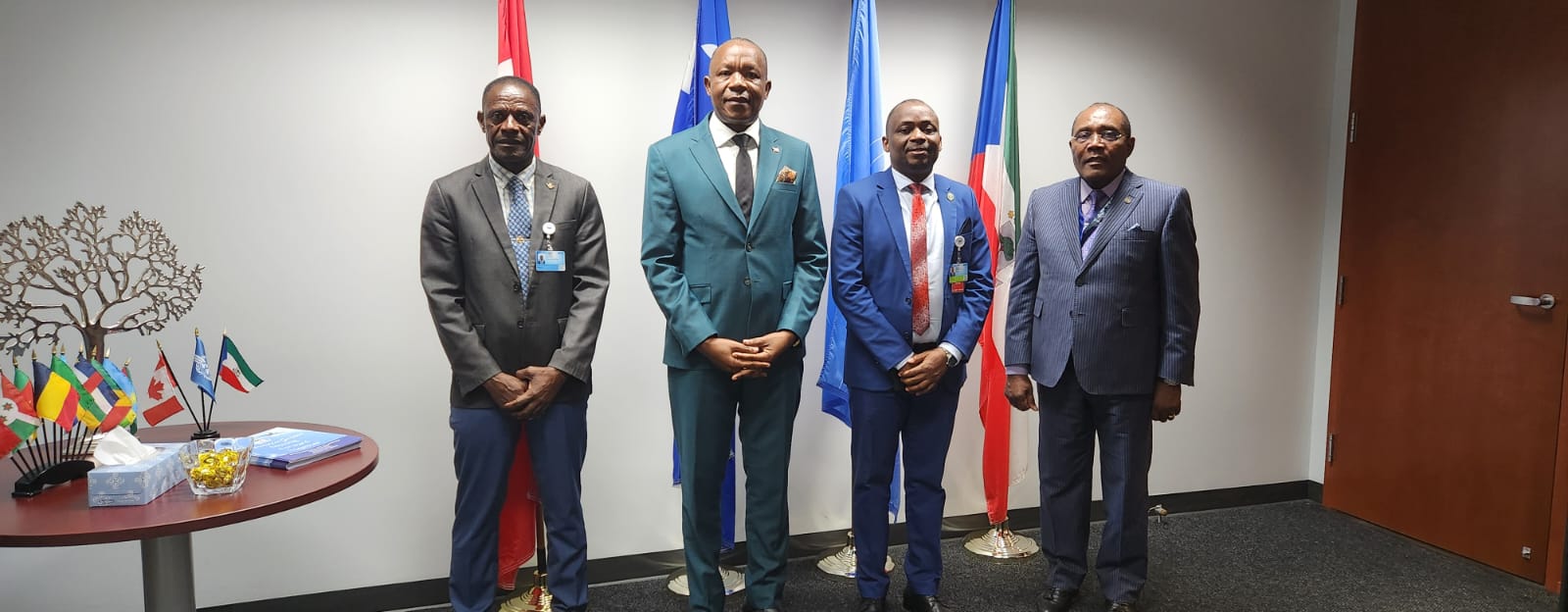
Equatorial Guinea has signaled strong intent to join the Banjul Accord Group Accident Investigation Agency (BAGAIA), underscoring its commitment to regional safety cooperation and its interest in developing capacity for aircraft accident and incident investigation.
The development was confirmed on the sidelines of the 42nd International Civil Aviation Organization (ICAO) Assembly in Montreal on September 27, 2025, following a high-level meeting between Commissioner of BAGAIA, Engineer Charles Irikefe Erhueh and the Minister of Civil Aviation of Equatorial Guinea, Exemo. Sr. Narberth B. Monsuy Mane Andeme, alongside the country’s Permanent Representative to ICAO, Mr. Esono Anguesomo E.
According to the Commissioner, discussions were held on the modalities of membership and the pathways available to Equatorial Guinea under the recently amended legal framework of BAGAIA, which was updated in May 2025. He noted that the engagement was constructive and reflected Equatorial Guinea’s readiness to align with established protocols guiding membership.
“The deliberations focused on the way forward as already provided in the legal instrument of BAGAIA,” the Commissioner explained, stressing that the country’s inclusion would further strengthen the regional accident investigation mechanism. He described the discussions as encouraging, pointing out that the organisation looks forward to welcoming Equatorial Guinea once it fulfills the required obligations.
The Equatorial Guinea delegation praised the progress made by BAGAIA in strengthening aviation safety oversight, particularly following its cooperation agreement signed earlier with the Interstate Aviation Committee (IAC). It emphasised that Equatorial Guinea views regional collaboration as a strategic pathway to improving its aviation safety framework.
For Equatorial Guinea, the move also highlights a clear interest in building and enhancing national capacity for aircraft accident and incident investigation. Joining the regional structure would give the country access to shared expertise, pooled technical resources, and structured training opportunities that are vital for effective safety oversight.
Aviation experts note that Equatorial Guinea’s prospective membership would expand BAGAIA’s reach in West and Central Africa while reinforcing the principle of harmonisation in line with ICAO’s standards and recommended practices. It would also demonstrate growing regional solidarity in ensuring that accident investigation is approached with independence, professionalism, and consistency.
This milestone comes at a time when African states are increasingly recognising the importance of cooperative safety mechanisms to strengthen air transport reliability and boost passenger confidence. Equatorial Guinea’s step is therefore seen as a positive signal of its long-term commitment to safety, transparency, and accountability in civil aviation.